Oil & Fat Extraction and Processing Flowchart
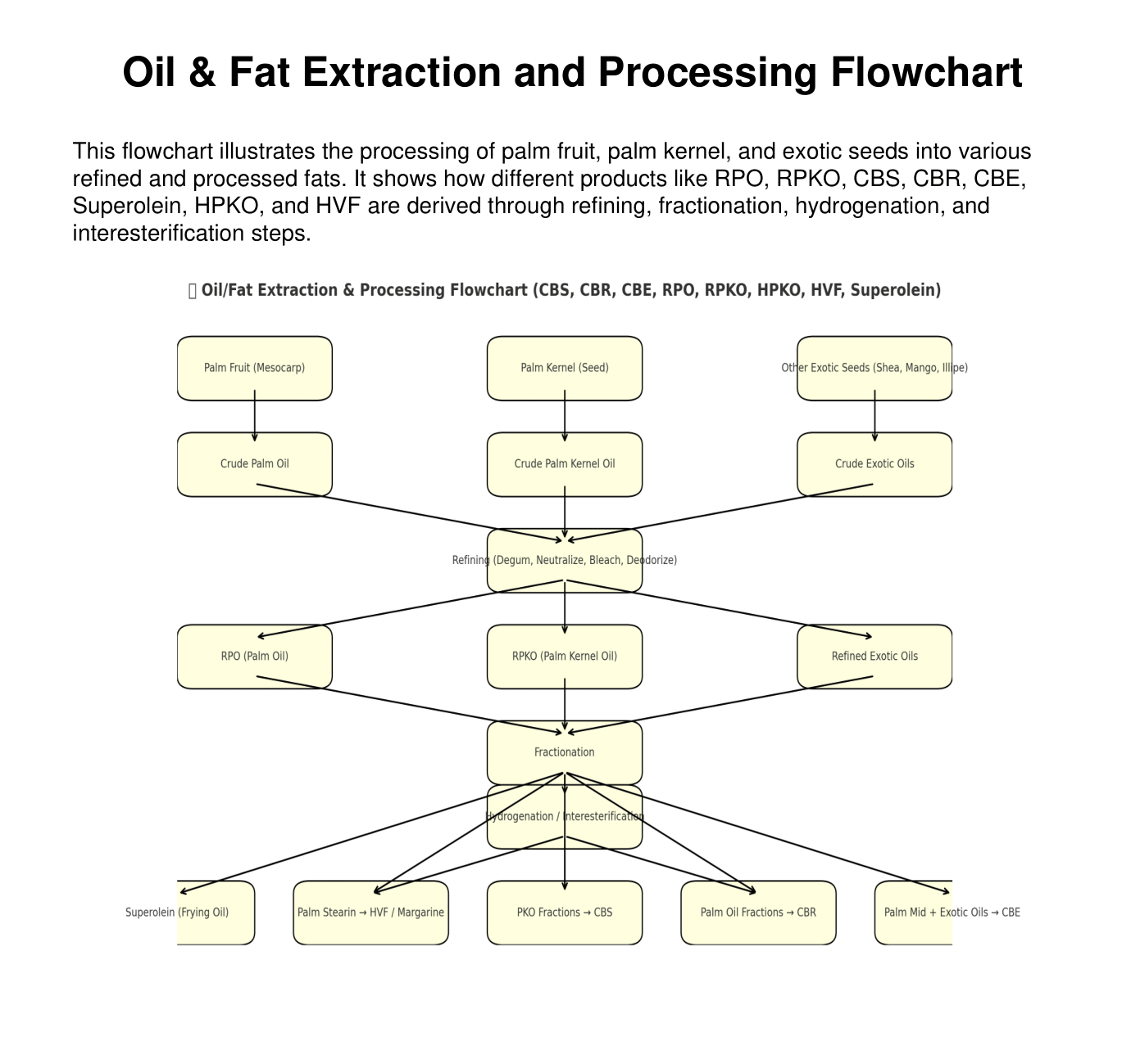
Summary / Purpose
This document provides a single-page visual flowchart and a concise SOP for processing palm fruit, palm kernel, and exotic seeds into refined oils and industrial fats. It's intended for plant technical teams and R&D documentation.
1. Raw Material Reception
- Palm Fruit (mesocarp) — received, washed, sterilized and pressed to obtain crude palm oil.
- Palm Kernel (seed) — de-shelled, crushed, and pressed/extracted to obtain crude palm kernel oil (CPKO).
- Exotic seeds (Shea, Illipe, Mango) — cleaned and pressed or solvent-extracted depending on seed hardness and yield.
2. Crude Oil Handling
- Settling/clarification to remove water and solids.
- Storage in heated, inerted tanks to avoid hydrolysis and oxidation.
- Quality checks: FFA, moisture, impurities, peroxide value.
3. Refining (RBD)
- Degumming — remove phospholipids (acid or water degumming).
- Neutralization — caustic treatment to reduce Free Fatty Acids (FFA) followed by washing.
- Bleaching — activated earth/bleaching clay to remove pigments and trace metals.
- Deodorization — steam distillation at high temperature under vacuum to remove volatile off-odors and residual free fatty acids.
Output: RPO (Refined Palm Oil), RPKO (Refined Palm Kernel Oil), and refined exotic oils.
4. Fractionation
Controlled crystallization and filtration separates oils into fractions:
- Olein — liquid fraction (Palm Olein, Superolein).
- Stearin — solid fraction (Palm Stearin).
- Mid-fraction — intermediate solid/liquid properties used for specialty fats like CBE.
Key parameters: cooling rate, stirring, crystallization temperature, filtration media.
5. Modification Processes
- Hydrogenation — hydrogen added over catalyst (nickel) to raise melting point and increase solidity (used for HPKO, HVF). Monitor iodine value and trans fat formation.
- Interesterification — enzymatic or chemical rearrangement of fatty acids on glycerol to tailor melting profile and plasticity (used for CBR, CBS tuning, margarine fats).
- Blending — combine fractions, exotic fats and modified oils to achieve target TAG profile and melting characteristics for final products (CBE, CBS, CBR).
6. Product Finishing & QC
- Polishing/filtration and additive dosing (anti-oxidants like TBHQ, BHA if needed).
- Quality tests: melting behavior (drop point), solid fat content (SFC), melting profile (DSC), free fatty acids, peroxide value, moisture).
- Packaging in appropriate containers (drums, IBCs, tankers) under nitrogen if required.
7. Typical Routes to Finished Products
- CBS (Cocoa Butter Substitute) — from PKO fractions or hydrogenated PKO fractions followed by interesterification to attain lauric-rich, sharp melt.
- CBR (Cocoa Butter Replacer) — from palm oil fractions (non-lauric) with controlled interesterification/hydrogenation for a softer chocolate fat used in compound coatings.
- CBE (Cocoa Butter Equivalent) — blends of palm mid-fraction and exotic kernel fats (shea, illipe) designed for triglyceride compatibility with cocoa butter; requires tempering like cocoa butter.
- Superolein — highly liquid palm olein fraction produced by multiple fractionation steps used as high-quality frying oil.
- HPKO — hydrogenated palm kernel oil (solid) for confectionery coatings and shortenings.
- HVF — hard vegetable fat produced by fractionation/hydrogenation for margarine, vanaspati, bakery shortenings.
8. Safety & Environmental Notes
- Control emissions during deodorization and hydrogenation (VOC & catalyst handling).
- Manage spent bleaching earth and neutralization effluent per local regulations.
- Use oxygen-free blanketing for storage of refined oils to delay oxidation.
Chocolate Fats Flowchart
A visual guide: how palm fruit & kernel become different fractions (Olein, Stearin, PMF) and how those feed into CBS/CBE used in chocolate production.
Quick notes:
- Super Olein = double-fractionated olein (very stable liquid) used for frying, not for solid chocolate.
- CBS is lauric (from PKO) — cheap and used in compounds; CBE is non-lauric (PMF/she degree) and can be blended with cocoa butter.
- PMF is the most valuable fraction for confectionery — formulated to mimic cocoa butter triglycerides.